ISO 27001 Risk Assessment: The Most Common Risks to Look Out For
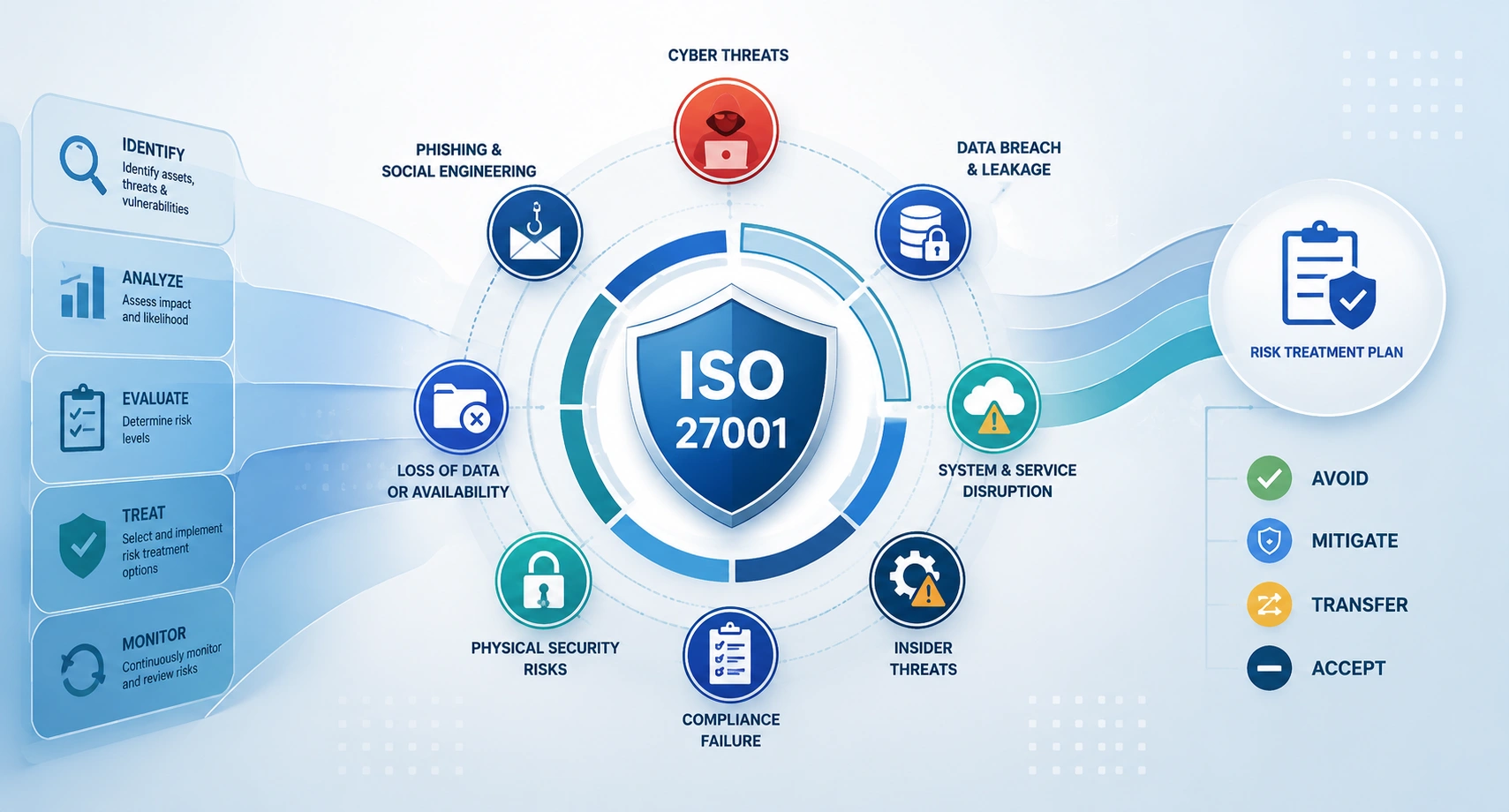
What are the most common ISO 27001 information security risks, and how can organizations manage them effectively?
This guide explains the purpose of an ISO 27001 risk assessment, identifies the most common information security risks organizations face, and outlines practical strategies for evaluating, treating, and continually managing risk within an Information Security Management System (ISMS).
Protecting sensitive business information requires more than implementing security controls. Organizations also need a structured process for identifying, evaluating, and managing risks before they develop into incidents. That’s exactly why risk assessment is a core requirement of ISO/IEC 27001.
Every organization faces different information security challenges. Cyber threats continue to evolve, technology changes rapidly, and business processes become more interconnected each year. An effective ISO 27001 risk assessment helps organizations understand where their greatest vulnerabilities exist and prioritize actions that reduce the likelihood and impact of security incidents.
A well-executed risk assessment also demonstrates that information security is being managed systematically rather than reactively. During an ISO 27001 certification audit, auditors expect to see evidence that risks have been identified, evaluated, treated appropriately, and reviewed as part of an ongoing Information Security Management System (ISMS).
This guide explains some of the most common information security risks organizations encounter and outlines practical approaches for managing them within an ISO 27001 risk management framework.
What Is an ISO 27001 Risk Assessment?
An ISO 27001 risk assessment is the structured process of identifying, analyzing, evaluating, and prioritizing information security risks that could affect an organization’s Information Security Management System (ISMS). It enables organizations to understand where threats exist, determine the potential business impact, and select appropriate controls to reduce risk to an acceptable level.
Rather than treating security as a checklist exercise, risk assessments encourage organizations to make informed decisions based on their business objectives, regulatory obligations, technology environment, and risk appetite. This makes the risk assessment one of the most important activities within an ISO 27001 implementation.
Risk assessments should not be viewed as a one-time exercise performed solely before certification. They are intended to support continual improvement throughout the life of the ISMS and should be reviewed whenever significant organizational, technological, or regulatory changes occur.
If your organization is preparing for certification or strengthening an existing Information Security Management System, professional ISO 27001 Risk Assessment services can help identify security risks, prioritize treatment activities, and improve audit readiness before formal certification.
Common ISO 27001 Risks Organizations Should Watch For
Every organization has a unique risk profile, but several information security risks appear consistently across industries. Understanding these common threats helps organizations build more effective risk treatment plans and strengthen overall security resilience.
Human Error
Human error remains one of the most common causes of information security incidents. Employees may accidentally disclose confidential information, respond to phishing emails, use weak passwords, or bypass established security procedures.
Reducing this risk requires more than publishing security policies. Regular awareness training, practical guidance, and ongoing communication help employees recognize threats and understand their role in protecting organizational information.
- Phishing attacks
- Weak password practices
- Improper handling of confidential information
- Failure to follow security procedures
- Insufficient security awareness
Organizations that invest in continuous security awareness training often reduce avoidable security incidents while strengthening overall compliance.
Malware and Ransomware
Malware and ransomware continue to present significant operational and financial risks for organizations of all sizes. These attacks can interrupt business operations, compromise sensitive information, and create costly recovery efforts.
Managing these threats requires a layered approach that combines technical safeguards with operational controls.
- Endpoint protection
- Timely security patching
- Secure backup strategies
- Network monitoring
- Incident response planning
Organizations that regularly test their security controls are generally better prepared to respond when security incidents occur.
Third-Party and Cloud Service Risks
Many organizations depend on cloud providers, managed service providers, software vendors, and outsourced business partners. While these relationships improve efficiency, they also introduce additional information security risks that remain the organization’s responsibility.
Supplier risk management should include due diligence, contractual security requirements, ongoing monitoring, and periodic reviews of third-party security performance.
- Cloud service outages
- Supplier security weaknesses
- Data processing risks
- Third-party access management
- Vendor compliance reviews
Managing supplier relationships effectively helps reduce operational disruption while strengthening overall Information Security Management System governance.
Outdated Systems and Unpatched Software
Unsupported operating systems, outdated applications, and delayed software updates remain common causes of security vulnerabilities. Attackers frequently target known weaknesses that could have been addressed through routine patch management.
Organizations should maintain structured vulnerability management processes that prioritize updates according to business risk and criticality.
- Software patch management
- Vulnerability assessments
- Unsupported systems
- Configuration management
- Technology lifecycle planning
Keeping systems current significantly reduces exposure to many well-known cybersecurity threats.
Unauthorized Access and Privilege Misuse
Information security risks are not always external. Excessive permissions, inactive user accounts, or inappropriate access to confidential information can create unnecessary exposure for any organization.
Access management should follow the principle of least privilege, with permissions granted only where required and reviewed on a regular basis.
- Excessive user privileges
- Inactive accounts
- Unauthorized data access
- Privilege escalation
- Insufficient access reviews
Strong identity and access management practices reduce both accidental errors and intentional misuse while supporting compliance with ISO/IEC 27001 requirements.
How Can Organizations Manage These Risks?
Identifying information security risks is only the first step. The real value of an ISO 27001 risk assessment comes from selecting appropriate controls, implementing effective risk treatment measures, and integrating security into everyday business operations.
Employee awareness is one of the strongest defenses against many common threats. Security policies are far more effective when employees understand why they exist, how they apply to daily responsibilities, and the role each individual plays in protecting organizational information.
Organizations should focus on practical security measures that reduce risk while supporting business objectives.
- Provide regular security awareness training
- Implement multi-factor authentication where appropriate
- Maintain timely software patching and vulnerability management
- Monitor systems continuously for unusual activity
- Review user access rights on a regular basis
- Test backup and incident response procedures periodically
Technical safeguards should always be supported by strong governance. Policies, documented procedures, management oversight, and continual monitoring help ensure that security controls remain effective as business requirements and threat landscapes evolve.
Organizations that treat risk assessment as an ongoing business activity rather than a one-time certification task are generally better positioned to respond to emerging threats while maintaining long-term compliance.
What Are the Six Phases of ISO 27001 Risk Management?
An effective ISO 27001 risk management process follows a structured methodology that helps organizations identify, evaluate, and treat information security risks consistently. While implementation approaches vary, most organizations follow six practical phases.
1. Define the Risk Assessment Methodology
Organizations begin by establishing how risks will be identified, analyzed, evaluated, and prioritized. A documented methodology creates consistency and supports repeatable decision-making throughout the Information Security Management System.
2. Identify and Assess Risks
Information assets, threats, vulnerabilities, existing controls, and potential business impacts are identified and evaluated. This assessment provides the foundation for selecting appropriate risk treatment measures.
3. Develop and Implement Risk Treatment Plans
Organizations determine whether risks should be reduced, transferred, accepted, or avoided. Risk treatment plans document selected controls, implementation responsibilities, target completion dates, and any remaining residual risks.
4. Document Assessment Results
Risk registers, assessment reports, management approvals, and supporting evidence demonstrate that identified risks have been evaluated and addressed using a structured process.
5. Validate Against the Statement of Applicability
The Statement of Applicability (SoA) confirms how Annex A controls have been selected, implemented, or excluded based on the organization’s risk assessment. Consistency between the SoA and risk treatment decisions is an important part of ISO 27001 compliance.
6. Monitor, Review, and Continually Improve
Risk management is an ongoing activity. Organizations should regularly review their risk assessments to reflect changing business processes, new technologies, regulatory developments, and emerging cybersecurity threats.
Key Takeaways
The following points summarize the most important concepts discussed throughout this guide.
- ISO 27001 risk assessments form the foundation of an effective Information Security Management System (ISMS).
- Human error, ransomware, third-party suppliers, outdated technology, and poor access management remain among the most common information security risks.
- Risk assessments should be reviewed regularly to reflect organizational and technological changes.
- Risk treatment combines governance, technical controls, employee awareness, and continual improvement.
- A structured risk management process strengthens audit readiness while improving long-term information security resilience.
If you’re preparing for certification or strengthening your existing Information Security Management System, our ISO 27001 consulting services can help you develop practical risk management processes, improve audit readiness, and build a more resilient security program.
Whether you’re implementing ISO 27001 for the first time or improving an established Information Security Management System, a structured risk assessment provides valuable insight into where your organization is most vulnerable and which controls deserve the highest priority.
At SecuraStar, we work with organizations to develop practical ISO 27001 risk assessment methodologies, perform gap assessments, support internal audits, and implement sustainable Information Security Management Systems aligned with ISO/IEC 27001 requirements.